by Rachel Stevens | February 19, 2026
Studying Music in Australia: Inside the Australian Institute of Music’s Global Vision—and Why They Added MET
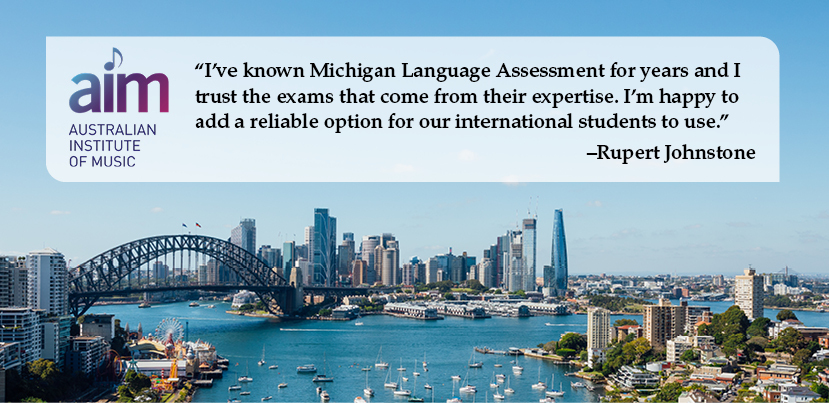
For students considering a creative education abroad, Australia can feel like a distant dream. But for the Australian Institute of Music (AIM), international students are critical to what makes AIM the strong creative community it is. AIM is dedicated to removing the barriers of international student admission, which is why AIM’s recognition of MET is a huge win for the institution and students alike.
This dedication stood out in a recent conversation with Rupert Johnstone, AIM’s international recruitment lead. Johnstone has worked with international students for decades, and he’s watched how English proficiency requirements can either support student mobility—or unintentionally slow it down. That’s why AIM’s recognition of MET mattered to him personally.
Johnstone said he has known Michigan Language Assessment and its tests for a long time and has always been fond of them. He described MET as a trusted, solid option, which is exactly the kind of assessment AIM is proud to include in its portfolio as the institution expands its international reach.
A boutique institution built for creative learners
With campuses in Sydney and Melbourne and nearly 60 years of history behind it, AIM occupies a distinctive place in Australian higher education. It is the country’s only dedicated music higher education provider, serving just under 1,000 students across both campuses.
“We’re a boutique institution,” Johnstone said. “We don’t teach engineering, IT, or business like a typical public university. We teach music, and music-related disciplines, so the campus becomes a genuine music community.”
AIM’s Sydney campus sits in The Rocks, one of the city’s most historic and artistic neighborhoods, with the Sydney Opera House on one side and the Sydney Harbour Bridge on the other. Students regularly work and collaborate on a rooftop garden overlooking the harbor—an environment AIM sees as integral to creative learning.
“For creative learners, environment matters,” Johnstone said. “Students aren’t just attending classes. They’re spending long hours on group projects, rehearsals, and performances. Being surrounded by that kind of energy and beauty shapes the learning experience.”
Small classes, high support
AIM’s model is intentionally personal. Performance students receive weekly one-to-one lessons, and even academic or business-focused classes are often small—more like seminars than lecture halls. Johnstone said that helps AIM identify struggles early and support students quickly, without separating “international support” from “general support.”
“It’s the polar opposite of lecture halls crammed with hundreds of students,” Johnstone said. “Because we’re small, we see students, and we can respond early.”
A global student body—and a changing trend
Today, approximately 25 percent of AIM’s students are international. AIM’s largest cohorts come from mainland China, followed by India and then countries across Southeast Asia, including Indonesia, Singapore, and Malaysia.
But Johnstone said one emerging trend has been a noticeable uptick in interest from the United States, both American students and international students previously studying there. He emphasized it’s not a “surge,” but it’s significant enough to shape strategy, especially as AIM develops partnerships with institutions like Berklee College of Music in Boston and the Los Angeles College of Music.
Australia’s student visa structure is part of the appeal: students can work up to 48 hours every two weeks during study periods and unlimited hours during holidays. Johnstone said that flexibility helps students manage costs and settle into life abroad more sustainably.
Why recognizing MET fits AIM’s international goals
As AIM scales up international recruitment, Johnstone said widening access matters—and that includes providing students with strong, recognized options for demonstrating English proficiency.
That’s where MET comes in.
Johnstone said he was genuinely excited to add MET because of how trusted and well-established it is. In his view, it’s a “solid” assessment that institutions can rely on, and students can feel confident preparing for, without the uncertainty that sometimes surrounds other English testing experiences.
“I’ve known Michigan Language Assessment for years and I trust the exams that come from their expertise,” Johnstone said. “I’m happy to add a reliable option for our international students to use.”
AIM’s recognition of MET also aligns with AIM’s broader approach to student success: reduce unnecessary friction, expand choice, and keep the focus on readiness and outcomes.
English development without one-size-fits-all
Rather than offering in-house English for Academic Purposes (EAP) programs, AIM partners with accredited language schools in Sydney and Melbourne. Johnstone said this gives students, especially postgraduate applicants, more realistic pathways to meet requirements and arrive academically prepared.
“For many students, meeting the band score requirements can be very challenging,” Johnstone said. “Listening is often the toughest.” He noted that encouraging students to arrive early, complete academic English coursework, and then take an approved exam can lead to better confidence and stronger transitions into their degree.
Music careers without borders
Music is increasingly global by default, and Johnstone said AIM graduates often build careers that span multiple countries—returning home, staying in Australia, or working across regions through collaboration, touring, and online production.
He pointed to modern tour circuits and regional hubs (including Japan, Korea, China, Singapore, and Australia) as proof that global mobility isn’t a niche outcome for musicians anymore, it’s the norm.
“Our students understand that being a performer isn’t enough,” Johnstone said. “They’re learning business, production, technology, and collaboration. They’re versatile—and they back themselves.”
Johnstone’s advice for prospective international students
When asked what advice he would give future AIM students, Johnstone’s message was direct: don’t wait until everything feels perfect.
“Creative students are bold by nature,” Johnstone said. “Come prepared, come with an open mind, and go all in.”
For students planning their next step, and for institutions looking to support them, AIM’s recognition of MET is one more way to make that leap clearer and more achievable: a trusted English assessment, added by an institution that values quality, credibility, and student outcomes.