by Rachel Stevens | June 23, 2026
What We Learned at LTRC 2026: Advancing English Language Assessment Through Research and Collaboration
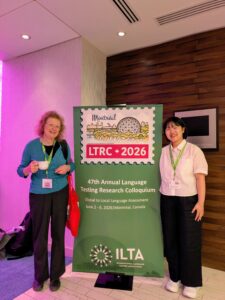
Every year, the Language Testing Research Colloquium (LTRC) brings together researchers, assessment professionals, and industry leaders from around the world to discuss the latest develo
pments in language assessment. As one of the premier conferences in the field, LTRC provides an opportunity to explore emerging research, exchange ideas, a
nd reflect on how assessment can better serve learners, institutions, and organizations worldwide.
This year, members of the Michigan Language Assessment team attended LTRC to learn from colleagues across the industry, share perspectives, and connect ongoing research with practical assessment applications.
Building Connections Across Research
For many attendees, one of the most valuable aspects of LTRC was the opportunity to see how different strands of research connect and inform one another.
“One of my favorite parts of the conference was making connections between different pieces of research on similar topics,” said Mika Hoffman, director of assessment at Michigan Language Assessment.
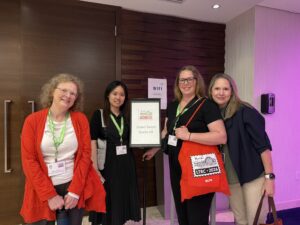
Rachel Basse, assessment supervisor at Michigan Language Assessment, highlighted the value of reconnecting with colleagues and staying informed about developments across the language assessment community.
“It was great seeing familiar faces and learning about what is going on in our industry,” Basse said.
These conversations help strengthen collaboration across organizations and ensure that advances in research continue to benefit language learners and assessment stakeholders worldwide.
Exploring New Innovations in Assessment
As expected, LTRC showcased a wide range of innovative research and emerging approaches to language testing.
Among the topics that stood out was research examining assessment impact from the test taker’s perspective. Hoffman explained that one organization is conducting innovative survey work to better understand how assessments affect learners and how those experiences can be measured and evaluated.
Another area of interest involved the use of detailed item-level analysis to generate more nuanced information about language proficiency levels, providing researchers with deeper insights into how language ability develops and can be assessed.
Artificial intelligence was also a major theme throughout the conference.
“There is so much innovative work happening with AI and integrating it into assessments, including AI speaking bots,” Basse said. “This is very exciting, but there are also many factors that need to be carefully considered, especially regarding validity.”
As AI continues to evolve, researchers across the industry are working to ensure that new technologies are used in ways that maintain assessment quality, fairness, reliability, and meaningful score interpretations.
How Michigan Language Assessment Contributes to the Conversation
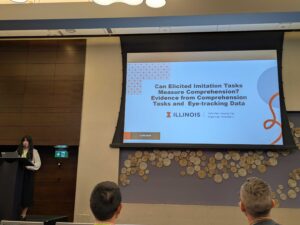
One of the recurring themes at LTRC was the importance of connecting research to real-world assessment practice—a principle that aligns closely with Michigan Language Assessment’s mission.
Many conference presentations focused not only on theoretical research, but also on practical implications for training, administration, scoring, and test design.
“Many presentations were not just theoretical. They focused on practical implications for training, facilitation, scoring, and test design,” Basse said. “This mirrors our mission of conducting research that informs operational assessment programs and improves fairness, consistency, and score quality.”
Michigan Language Assessment’s contribution to the field also extends beyond the research itself. Hoffman noted that presentations at this year’s conference included work from at least five former interns.
“We are helping shape the next generation of assessment research through our internship program,” Hoffman said.
By investing in emerging researchers and supporting evidence-based assessment practices, we continue to contribute to the advancement of language testing both within our organization and across the broader assessment community.