by Rachel Stevens | March 25, 2026
Staff Spotlight: Prakash Upadhyay on Expanding Global Opportunities Through English Assessment
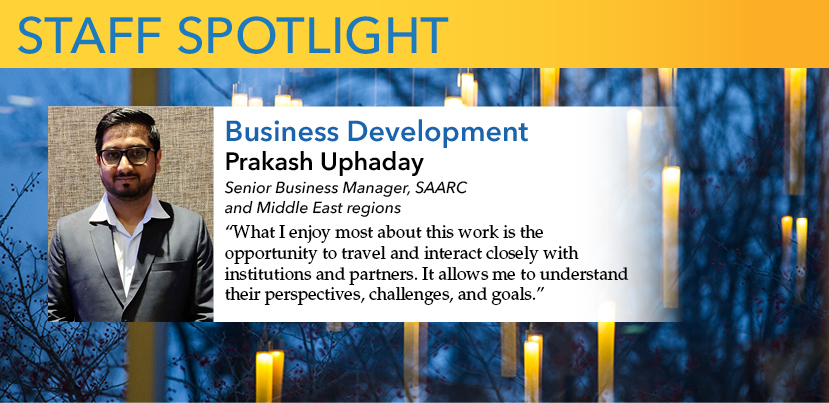
With more than 18 years of experience in the education sector and over a decade in international English language testing, Prakash Upadhyay brings deep industry knowledge and a global perspective to Michigan Language Assessment. As senior business manager for the SAARC and Middle East regions, Upadhyay focuses on expanding the reach of MET while strengthening partnerships across some of the world’s fastest-growing international education markets.
In this staff spotlight, Upadhyay shares insights from his career journey, observations about the evolving international education landscape, and advice for students planning to study abroad.
A Career Built in International Education
Upadhyay’s career spans multiple stages of the language assessment industry—from established global brands to emerging testing products.
Before joining Michigan Language Assessment, he worked with Cambridge University Press & Assessment, Pearson, and PSI, gaining experience with both mature and developing assessment programs.
“Initially, I was drawn to the strong reputation and global credibility of the Cambridge brand in international education and language assessment,” Upadhyay said. “Over time, while working in this industry, I developed a deep interest in the field, built strong relationships with stakeholders, and gained extensive experience.”
These roles allowed Upadhyay to see how different testing products grow and evolve in the global market.
“Being part of these different stages—from established brands to developing and new products—gave me a well-rounded perspective of the assessment industry,” Upadhyay said.
Today, at Michigan Language Assessment, he applies that experience to help expand the presence of MET in South Asia and the Middle East.
Supporting Growth in Dynamic Markets
In his role, Upadhyay leads regional strategy and business development across India, Bangladesh, Nepal, and surrounding markets. His day-to-day work includes business planning, building partnerships, managing regional teams, and supporting institutions that adopt the Michigan English Test.
These markets are experiencing significant growth in international education demand.
“One of the most exciting developments is the growing awareness among students and institutions about the importance of global mobility and internationally recognized credentials,” Upadhyay said.
Students across South Asia continue to pursue opportunities abroad while also recognizing the value of English proficiency for career advancement.
“English-language credentials are no longer viewed only as a requirement for studying abroad,” Upadhyay said. “Increasingly, they are seen as an important skill that can enhance global employability and professional opportunities.”
The region’s young population and strong cultural emphasis on education also contribute to the continued expansion of international education pathways.
“South Asia is incredibly dynamic because of its large and ambitious student population,” Upadhyay said.
What Students and Institutions Need Most
Upadhyay notes that both students and institutions are becoming more selective when choosing English assessments.
For students, accessibility and transparency are key.
“Students want a test that is trusted globally, easy to access, and provides a smooth testing experience,” Upadhyay said. “Many students are also looking for faster results and flexible test options so they can meet tight university or visa deadlines.”
Institutions and partners, on the other hand, prioritize reliability and credibility.
“They want assessments that are recognized internationally and accurately reflect a student’s real language ability,” Upadhyay said. “At the same time, they value strong partner support, training, and resources that help them guide students effectively.”
Building Partnerships That Matter
A major part of Upadhyay’s role involves working directly with institutions, agents, and partner organizations across the region. These partnerships help expand awareness of MET while strengthening international education networks.
“What I enjoy most about this work is the opportunity to travel and interact closely with institutions and partners,” Upadhyay said. “It allows me to understand their perspectives, challenges, and goals.”
One particularly meaningful collaboration has been with the Association of Australian Education Representatives in India (AAERI).
“Working with prestigious organizations like AAERI is particularly special because it provides the opportunity to connect with hundreds of Australian education agents under one umbrella,” Upadhyay said.
These collaborations help increase awareness of trusted assessments while supporting institutions that guide students through the international education process.
Why Institutions Choose MET
Upadhyay highlights several factors that make the Michigan English Test appealing to institutions and partners.
“MET is backed by respected institutions such as the University of Michigan and Cambridge University Press & Assessment, which enhances its credibility and global recognition,” Upadhyay said.
He also notes that the exam’s strong compliance standards and carefully maintained testing network help ensure consistent quality.
“The strict eligibility criteria for becoming a Test Center partner help maintain quality control and protect the integrity of the testing process,” Upadhyay said.
Beyond credibility, MET is designed to reflect real communication skills.
“The test uses practical and relatable topics, making it easier for students to understand the questions and demonstrate their true language ability,” Upadhyay said.
MET scores are accepted by thousands of institutions in the United States and recognized by Australia’s Department of Home Affairs, allowing students to use the exam for both academic and immigration pathways.
Collaboration Across a Global Team
Working with colleagues around the world has also been a rewarding aspect of Upadhyay’s experience at Michigan Language Assessment.
“What I enjoy most about working with the global team is the opportunity to collaborate with people from diverse backgrounds and cultures,” Upadhyay said.
This global perspective continues to shape his professional development.
“Working with the Michigan Language Assessment global team has helped me broaden my perspective, not only in terms of professional knowledge but also in understanding different working styles and cultural viewpoints,” Upadhyay said.
A Consultant’s Approach to Business Development
Although business development roles are often associated with high pressure and sales targets, Upadhyay views the work differently.
“Sales or business development roles are often seen as highly stressful because of the targets attached to them, but I genuinely enjoy what I do,” Upadhyay said.
He believes the key is focusing on solutions rather than transactions.
“If you position yourself as a consultant or a solution provider rather than just someone trying to sell a product, the conversation becomes more meaningful and productive,” Upadhyay said.
Understanding partner needs and building trust naturally leads to success.
“When you understand the client’s needs and offer the right solution, achieving targets becomes a natural outcome rather than a burden,” Upadhyay said.
Advice for Students Planning to Study Abroad
For students in South Asia considering international education, Upadhyay encourages careful planning and independent research.
“Studying abroad is a life-changing decision, so it is important not to rush the process,” Upadhyay said. “Spend time understanding your interests, strengths, and long-term career goals before making any major decisions.”
He also recommends looking beyond university rankings when choosing programs.
“Focus on factors like program relevance, career outcomes, affordability, and the support available for international students,” Upadhyay said.
Preparing early for English proficiency testing is another important step.
“Students should explore the options accepted by their preferred universities, including the Michigan English Test, and choose the one that best fits their preparation and timeline,” Upadhyay said.
Above all, he encourages students to remain confident and open to learning as they pursue global opportunities.